

This material is a translation of an original article by Alla Khotsianivska for Crimea.Realities, dated November 4. Read original article in Ukrainian here.
Lights on around the clock and Gundyaev on the loudspeaker (Vladimir Gundyaev, Patriarch of Moscow and All Rus’ Kirill – ed.). Kostiantyn Davydenko spent seven and a half years in Russian prisons.
The Ukrainian was detained by Russia’s Federal Security Service (FSB) in annexed Crimea in 2018. He had traveled there as a property appraiser to work with Ukrainian companies that wanted to leave the Crimean Peninsula. He was accused of espionage and cooperation with Ukraine’s Security Service (SBU).
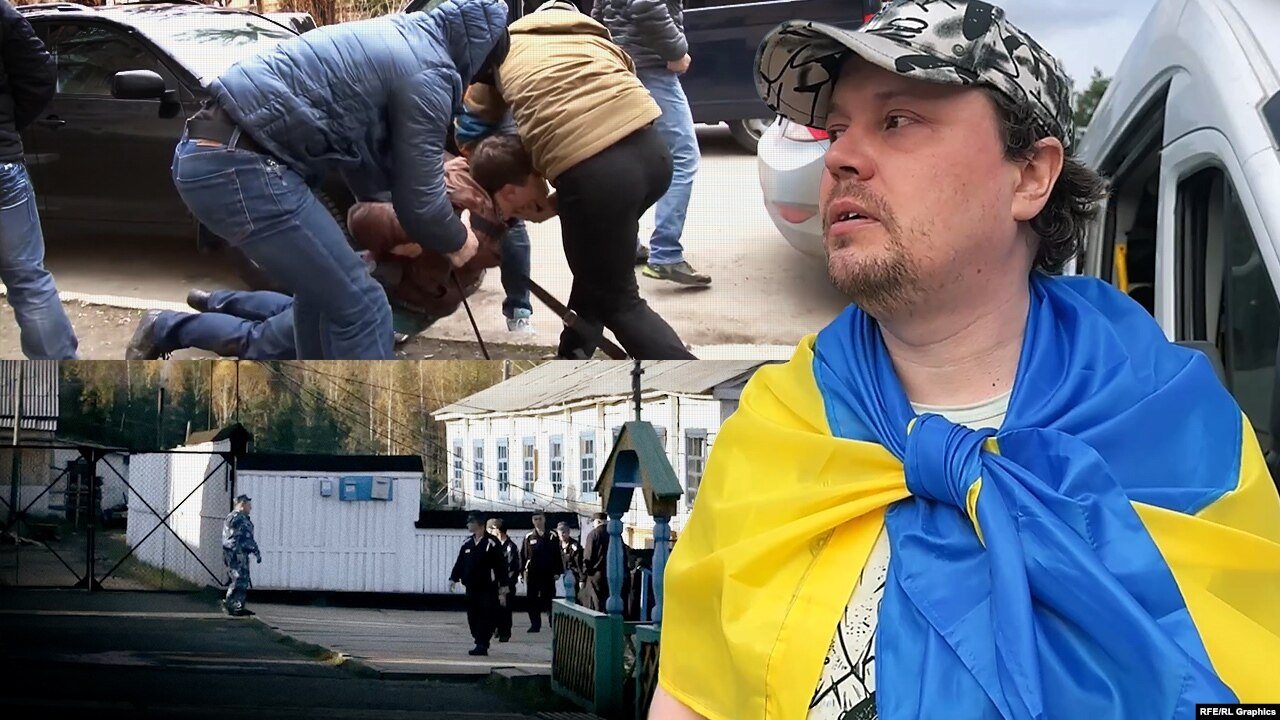
Kostiantyn’s detention, interrogations, and court proceedings were filmed and later used for propaganda to promote pro-Russian narratives in Crimea. Davydenko says he was subjected to torture and psychological pressure, abused in various ways by Russian security forces who tried to break him. After he had served his full sentence, they continued to hold him in a deportation center and even threatened to send him to serve in the Russian army.
A resident of Donetsk region, Kostiantyn Davydenko spent seven and a half years in Russian prisons. Russia refused to release him even after he had fully served his unlawful sentence. Until the very last moment, Kostiantyn did not believe he would return home. This photo was taken on the day of the exchange – August 24, 2025. The Commission under the Ministry for Communities and Territories Development of Ukraine officially recognized Davydenko as a political prisoner.

“I didn’t believe until the very end that everything would be okay. I kept thinking something would go wrong – that the exchange would be canceled, that someone would be forgotten, that we wouldn’t be brought there. I finally calmed down only when we turned toward the former checkpoint and saw our guys there, wearing our patches. That’s when it hit me – it was over. Then the emotions came, indescribable emotions – joy. And of course, joy that you’re finally free, finally home. That it’s finally over,” says Kostiantyn Davydenko.
Kostiantyn is from Donbas, from the city of Shakhtarsk. He worked as a property appraiser and had his own business, which he lost after Russia occupied his hometown in 2014. Later, he received a job offer in Crimea, which had already been annexed by Russia. He says he agreed because he had contracts on the peninsula even before its seizure by Russia. He traveled there with his wife and son.
“I had contracts with several banking institutions in Crimea. My task was to come and assess the damage caused to banks by the annexation of Crimea. The banks lost collateral property, lost branches and ATMs. All of that costs money and had to be assessed so that banks could bring their financial reporting into compliance and understand their losses. After this contract was completed at the end of 2015, I left Crimea. Later, from time to time, there were requests from Ukrainian citizens who still had property in Crimea and were re-registering it under Ukrainian law,” Kostiantyn explains.
At the end of 2015, he and his family moved to Kharkiv, while he continued to occasionally travel to annexed Crimea for work, as an appraiser must be physically present at the site. He says he understood all the risks, but after losing his business he had to find a way to earn a living. In February 2018, FSB officers seized Davydenko right on the street in Simferopol.
“I was in the office of my colleagues, Crimean appraisers who helped me with inspections. I was leaving the office and heading toward my car when they attacked me from behind, knocked me down, started beating me, tying my hands and head, shoved me into a van and took me to a basement. In that basement, very unpleasant procedures began. For about three or four hours – maybe longer, I lost track of time – they beat me. They tied me to a chair, fixed my hands as low as possible so I was bent backward, making it easier to beat my chest so I couldn’t breathe, and at the same time they strangled me from behind. That was their ‘entertainment.’ They kept shouting: ‘That’s it, Banderite, you’re done, we’ll kill you here, cripple you – the FSB is working.’” He says that later an investigator came in and said: “Stop torturing him, I still need to film him.”
“He said, ‘I’m such-and-such, an FSB investigator,’ he was the only one without a balaclava. And he said: ‘We accuse you of espionage. Here is your confession – sign it.’”
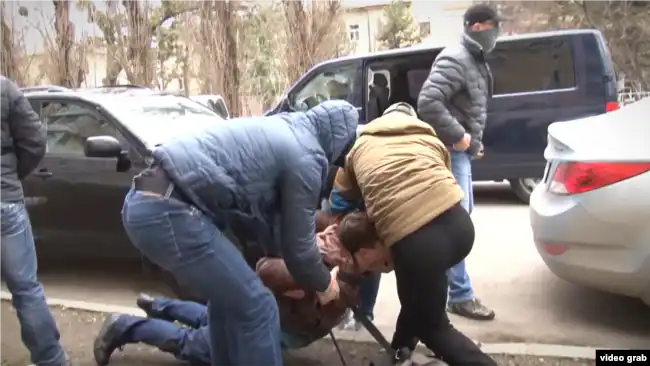
Ihor Kotelianets, Head of the Association of Relatives of Political Prisoners of the Kremlin, says that Russian security services closely monitored Ukrainians who entered occupied Crimea and did not have local registration. The filmed detentions of such individuals were aimed primarily at the local population as a tool for promoting Russian propaganda narratives.
“Look, Russia has been here since 2014, and all these ‘terrorists,’ Ukrainian ‘Banderites,’ are supposedly coming to kill you all, to carry out terrorist attacks or spy with the same goal. And we detain them all here to prevent that from happening. If you don’t live here, if you don’t have property or business interests here, you are likely considered a potential threat. These people who come here can see military equipment, can see Russian soldiers, can see what is happening, and can pass this information on,”
Kotelianets explains, describing the methods used by Russian security services in their work with the population of annexed Crimea.
After the interrogations, Davydenko was transferred from Simferopol to Moscow. The Lefortovo District Court ordered his pre-trial detention, and Kostiantyn was placed in the Lefortovo remand prison.
“They use psychological pressure there – constant humiliation, constant threats. They find your weak spot. For me, it was my family, and that’s exactly where they pressed. They brought me interrogation records of my father, my mother, and my sister. They really did interrogate them and threatened that if I refused to sign what they demanded, those interrogations would become more aggressive – and possibly even deadly,”
Kostiantyn says.
According to Kostiantyn, the conditions in the remand prison were deliberately designed to break a person. The toilet and the bed were in the same room, and the lights were intentionally never turned off.
“The cell was about two by three meters – not even really a cell, but a toilet, because there was a bucket, a sink, and your little bed. The light was on all the time, and there was a loudspeaker. One day it played Spas Radio – religious broadcasts where Gundyaev blesses people and talks about ‘great Orthodoxy.’ The next day it was Army Radio, where it’s ‘Victory Day’ every single day. You can’t turn it off, you can’t lower the volume. It breaks a person. All of this is meant to make you feel helpless. There are constant searches, constant forced stripping. Before an interrogation, they take you out of the cell and make you strip completely — even though there is obviously nothing on you. What could there be, when the cell is bare, the walls are bare, and you have nothing except prison clothes? Still, they strip you, pat down your belongings, inspect you thoroughly. You’re not allowed to cut your hair, shave, or wash properly. They give you a small piece of soap — that’s it. Harsh, abrasive soap. You have to use it both to wash yourself and to do your laundry. You don’t want to walk around dirty and stinking — you want at least to look somewhat decent, to feel human. And that single piece of soap is all you have. Everything there is set up to turn you into an animal, to break you. And it broke many people. I saw people there who were completely broken,”
Davydenko recalls.
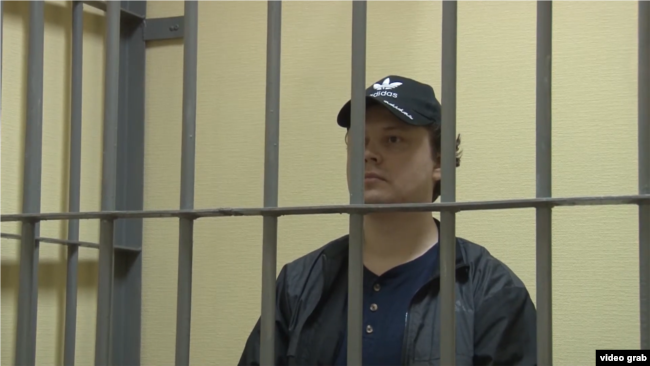
In Crimea, the trial was held behind closed doors, and no one was allowed to attend the hearings. Kostiantyn was held at Simferopol Remand Prison No. 2. Davydenko was accused of alleged espionage and cooperation with the Security Service of Ukraine, claiming that he had collected and passed on information about the activities of Russia’s National Guard and the FSB.
The Russia-controlled Supreme Court of Crimea illegally sentenced Kostiantyn to ten and a half years in a maximum-security penal colony. After an appeal was filed, the sentence was reduced to seven years. Kostiantyn was transferred to Penal Colony No. 23 in the settlement of Kamensky, Saratov region, Russia. He says he was the only political prisoner there; the other Ukrainians were serving sentences for criminal offenses.
“FSB officers were supposed to write reports on me – what I was doing, how I was feeling. That was the only thing that set me apart. After the full-scale invasion, of course, this changed. One of the deputy wardens became obsessed with the issue and began banning Ukrainians from using the Ukrainian language, banning Ukrainian songs on the radio, and banning Ukrainian-language programs on television. The guys found Kobzar in the prison library – it even had a stamp saying it had been checked and approved in Ukrainian. But when he saw Kobzar, he called it extremist literature. I told him: I took it from your library, with your stamp – it says right here that it’s approved. He looked at me as if I didn’t know what I was reading. And that attitude extended to all Ukrainians, not just me. I wasn’t singled out because of my charge – Ukrainians as a whole had simply become the enemy,”
Kostiantyn recalls.
Davydenko served seven years of his sentence. After his release from the penal colony, the former political prisoner was immediately detained again and sent to a deportation center because his Ukrainian passport had expired. He was held there for another six months. He tried to secure deportation from Russia through the courts, but Davydenko says his lawyer was hinted that no further complaints should be filed.
“They told us, ‘Don’t go to court anymore – he will either be included in a prisoner exchange, or he will stay here, or he will be conscripted into the Russian army.’ Lithuania had hired a lawyer for me and was ready to accept me. They sent a letter to the Russian authorities saying they would cover all expenses – legal fees, transportation – and transfer me from Russia to Lithuania, and then from Lithuania to Ukraine, guaranteeing my return to Ukraine. But Russia refused. And in court, my lawyer was quietly taken aside and hinted that this would be my fate. And that’s exactly how it works – we all know the case of Lymeshko, who was taken from a deportation center back to a remand prison and given a new sentence. That was my greatest fear – that the same thing would happen to me,”
Davydenko says.
Ihor Kotelianets says that there was a separate court decision concerning Davydenko – effectively authorizing his indefinite detention in Russia, despite the fact that the Russian Federation has the ability to deport Ukrainian citizens through the border crossing with Georgia.
“An instruction came down from the FSB to prevent him from leaving, to keep him detained, and to invent any grounds necessary to hold him in the Temporary Detention Center for Foreign Nationals. And they did exactly that. A court hearing was held, and the court ruled that since he is a citizen of Ukraine, and since there is allegedly no current communication with Ukraine, no safe border crossing, and no possibility of transferring him to Ukraine, he should continue to be held until such communication is restored – essentially something entirely new. That means indefinite detention without grounds and without any real justification,”
Kotelianets explains.
During his imprisonment, Kostiantyn lost contact with his family. After the start of Russia’s full-scale invasion, they fled abroad.
“Our consular services are now helping me search for them – where my wife registered as a displaced person, when and where she was taken. The search is ongoing. My wife and son are truly the people I held on for during those seven years – just to see them again, to be with them again,”
says Davydenko, a former prisoner of Russian prisons.
He also hopes to evacuate his elderly parents from occupied Donbas. For now, he is restoring his health. While in the colony, he suffered a stroke that went untreated, leaving him with serious complications. He also plans to resume his work as a property appraiser – he wants to be useful here, in Ukraine.
This material is a translation of an original article by Alla Khotsianivska for Crimea.Realities, dated November 4. Read original article in Ukrainian here.