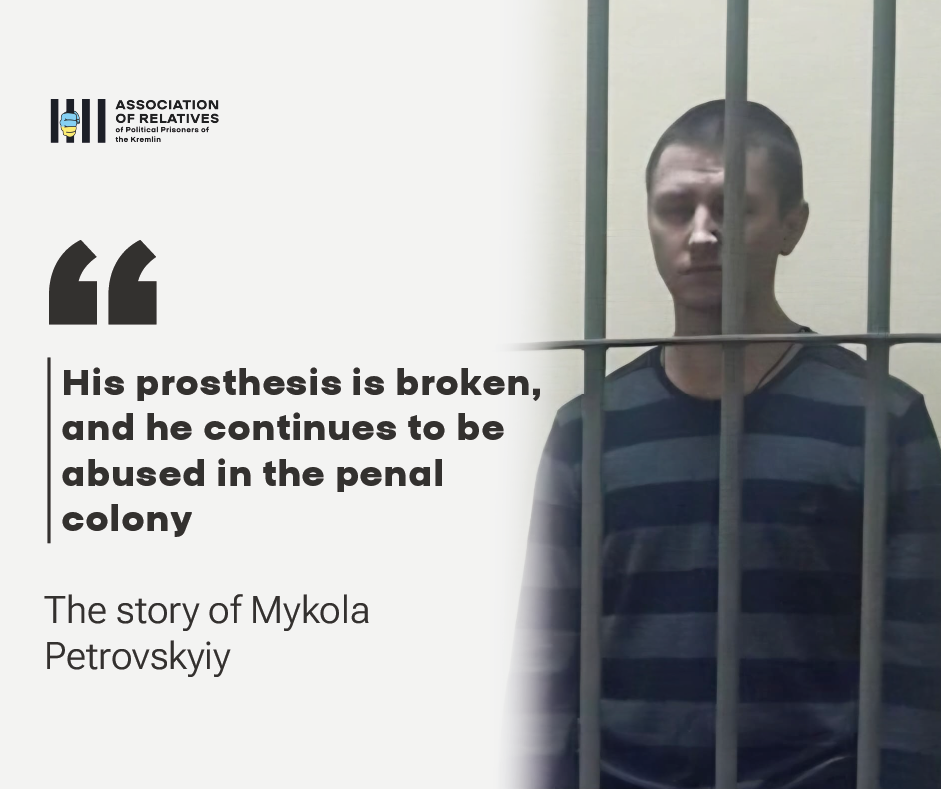


Mykola Petrovskyi lived in Kherson with his father and grandmother. As a result of two serious car accidents, he had a Group III disability, used a prosthesis, and required constant medical care. Before the full-scale invasion, he had earned a law degree and was active in civil society and volunteer work. From the start of the occupation, Mykola gathered information about the situation in the city and delivered food to elderly people and families of military personnel.
On 27 March 2022, Mykola left for a meeting with an acquaintance. He stopped responding to messages that same evening. In a brief phone call to his father, he said he was with friends. The family later realised that, by that point, he had likely already been detained. According to available information, this happened near a café in Kherson.
The next morning, armed members of the occupying forces wearing "FSB" and "Rosgvardiya" insignia came to the Petrovskyis' home. They searched the house and took phones, documents, electronics, and money. Mykola was brought into the house under guard, already beaten — with abrasions on his head, injured fingers on his uninjured leg's foot, and severe pain in his shoulder. Father and son were then driven away from the house with bags over their heads, in separate vehicles. The father was released after about an hour and a half. For a long time, nothing was known about Mykola's fate.
On 1 April 2022, Mykola made a brief call to his father — just enough to say he was alive. It later emerged that on 2 April he had been moved to Pre-Trial Detention Centre No. 1 in Simferopol. Only at the end of September 2022 did the family learn, from a lawyer assigned by the Russian side, that Mykola was being charged with "espionage." Until then he had been held without any procedural status, without being formally notified of suspicion, and without a court hearing.
From October 2022, Mykola was held in Pre-Trial Detention Centre No. 2 in Simferopol, run by the FSB. According to his own and his father's accounts, he was beaten, starved, tortured, and denied proper medical care during his detention. On 27 September 2023, the so-called "Supreme Court" of Crimea found him guilty of "espionage" and sentenced him to 16 years in a maximum-security penal colony. The trial was held behind closed doors. His appeal was unsuccessful.
After the verdict took effect, Mykola was transferred through several detention sites in Russia and eventually delivered to Penal Colony No. 4 in the town of Pugachev, Saratov region. In January 2026, the colony's administration accused him of allegedly breaching the regime, placed him in solitary confinement, and then moved him to a high-security unit. His prosthesis is completely broken; he can barely walk on his own; he has a curved spine, hernias, a cyst, recurrent boils, a high fever, and severe headaches. Despite his serious condition, the colony administration is attempting to force him to do labour.
Mykola's father has appealed to Ukrainian authorities, international organisations, and the Red Cross. In 2022, Mykola was officially recognised as a person deprived of personal liberty as a result of the armed aggression. He remains unlawfully held, and his health continues to deteriorate.
The documentation of war crimes is carried out with the financial support of the European Endowment for Democracy (EED). Its content does not necessarily reflect the official position of EED. The information and views set out in this publication are the sole responsibility of the NGO Association of Relatives of Kremlin Political Prisoners.
The Union systematically documents war crimes and works to free civilians and support their families.